Why Data Centers Need Raised Floors: A Complete Guide
As Bangladesh rapidly embraces digital transformation, the demand for robust IT infrastructure is skyrocketing. From banks to telecommunication giants, organizations across Dhaka and beyond are establishing sophisticated data centers to power their operations.
When designing a high-performing server room or data center, every structural element matters. However, one foundational component is often undervalued until the hardware arrives: the floor.
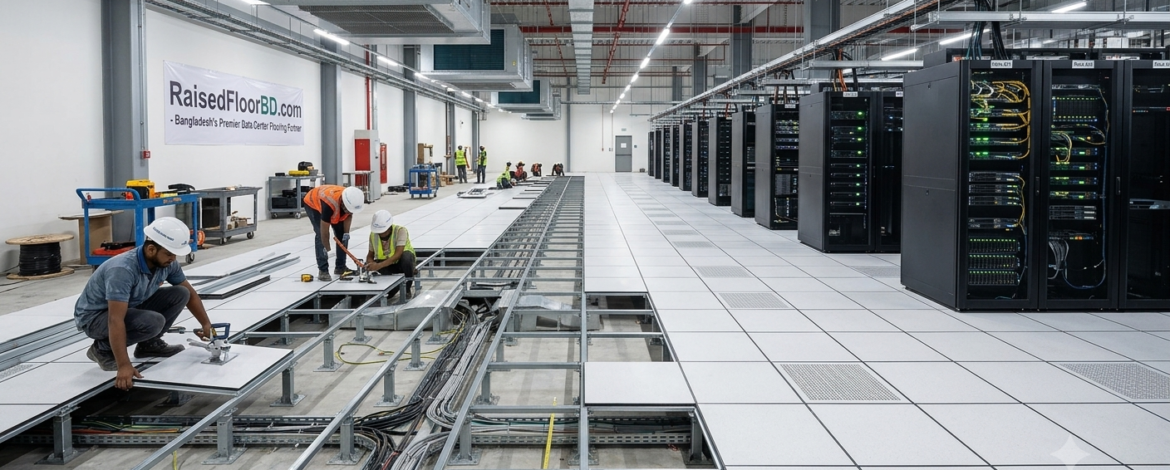
As shown in image_ccfad3.png, implementing a raised floor is not just an aesthetic choice—it is a critical requirement for modern IT facilities. Here is a complete guide on why data centers absolutely need raised floor systems.
1. Efficient Cable Management and Organization
Data centers house an overwhelming volume of power lines, network cables, and fiber optics. Running these across a traditional concrete floor creates a chaotic environment and a massive tripping hazard.
A raised floor system creates a dedicated, hidden plenum beneath the panels. This allows engineers to lay down structured cable trays seamlessly. It keeps your server room looking clean, makes tracing faults easier, and simplifies the process of scaling up or adding new hardware.
2. Superior Cooling and Thermal Efficiency
Servers generate immense heat. Without an effective cooling mechanism, equipment will overheat, causing downtime, data loss, or permanent hardware damage.
Raised flooring acts as a massive distribution channel for cold air. By utilizing specialized perforated raised floor panels, cold air can be pushed up from the underfloor plenum directly into the cold aisles of your server racks. This localized, targeted airflow optimizes HVAC efficiency, significantly lowering electricity bills and reducing your data center’s carbon footprint.
3. Structural Flexibility and Future-Proofing
Technology evolves rapidly. The server setup you deploy today will likely look different five years from now.
Traditional flooring locks your layout in place. In contrast, a raised floor system offers unmatched flexibility. Need to move a heavy server rack or route a new batch of fiber cables? Using a specialized panel lifter, you can easily pop open individual floor tiles, re-route your infrastructure, and place them back down without interrupting ongoing operations.
4. Safety, Grounding, and Static Dissipation
Static electricity is the silent killer of sensitive microelectronics. Walking across standard flooring can build up static charges that, if discharged into a server chassis, could fry expensive motherboards.
Quality raised floors designed for data centers are finished with anti-static materials like High-Pressure Laminate (HPL) or vinyl. Combined with proper grounding to the underfloor pedestals and stringers, these systems safely dissipate static electricity, protecting your multi-million Taka hardware investments.
Key Components of a Reliable Data Center Floor
To build a floor capable of handling heavy server loads, you need to ensure the system utilizes high-quality components:
-
Steel/Cementitious Panels: Capable of handling high static and rolling weight loads.
-
Perforated Panels: To facilitate proper underfloor air conditioning distribution.
-
Adjustable Pedestals: Heavy-duty steel pillars to level the floor precisely, even if the sub-floor is uneven.
Secure Your Data Center with RaisedFloorBD
Building a data center in Bangladesh requires local expertise, durable materials, and a deep understanding of thermal engineering. At RaisedFloorBD, we specialize in supplying and installing top-tier raised access floor systems tailored specifically for server rooms, control hubs, and modern commercial offices.
Don’t let poor infrastructure compromise your digital assets. Contact us today to get a quote and learn how we can help you build a safer, cooler, and more efficient data center.