Upgrade Your Infrastructure with the Best Raised Floor for Datacenter Applications
Managing a modern data center requires an uncompromising approach to thermal management, massive structural loads, and complex cable pathways. Utilizing the best raised floor for datacenter design is no longer just an architectural choice—it is a core requirement for system longevity and operational efficiency. Engineered with high-grade steel, cementitious cores, and anti-static finishes, these systems form a robust, elevated grid that safeguards your mission-critical hardware.
By separating the cold air delivery underfloor from the hot exhaust overhead, our access flooring optimizes cooling efficiency, drastically reducing your facility’s power consumption while maintaining flawless organization.
Elevate Your Mission-Critical Infrastructure with Elite Underfloor Solutions
Every millisecond of uptime depends on the hidden infrastructure beneath your server racks. As high-density computing pushes power densities and heat dissipation to new extremes, standard flooring solutions simply crumble under pressure. Implementing the best raised floor for datacenter facilities solves three critical operational challenges at once: load distribution, precise cooling, and infinite flexibility for rapid scaling.
Advanced Thermal Control and Airflow Management
Modern blade servers generate intense heat, making traditional overhead cooling inefficient and costly. An elevated access floor turns the empty space underneath your equipment into a pressurized plenum (an enclosed chamber for air distribution). This allows cold air to travel directly to heavy-heat areas through high-volume perforated tiles.
By integrating airflow management devices, such as specialized brush grommets and directional air panels, you prevent hot and cold air from mixing. This exact control over air distribution eliminates dangerous hot spots, ensures stable hardware temperatures, and lowers your overall power usage effectiveness (PUE) ratios.
Exceptional Structural Integrity and Weight Distribution
Data center racks loaded with enterprise servers, battery backups, and heavy networking switches exert immense localized stress on your building’s structural footprint. Our heavy-duty steel and cement-filled panels are engineered to handle incredible static, rolling, and ultimate structural loads without bending or warping over time.
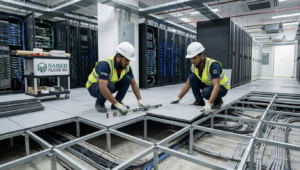
Supported by an adjustable steel pedestal and stringer understructure, the system distributes tons of equipment weight evenly across the subfloor. This guarantees a level, vibration-resistant foundation that easily meets rigorous seismic and industrial safety codes.
Future-Proof Cable and Utility Management
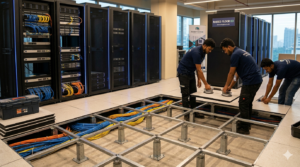
As your network grows, your wiring infrastructure will inevitably shift and expand. A modular raised floor serves as an accessible highway for power lines, fiber-optic cables, and liquid-cooling pipes. Gone are the days of tangled overhead trays or expensive construction work just to reroute a few wires.
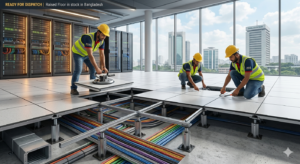
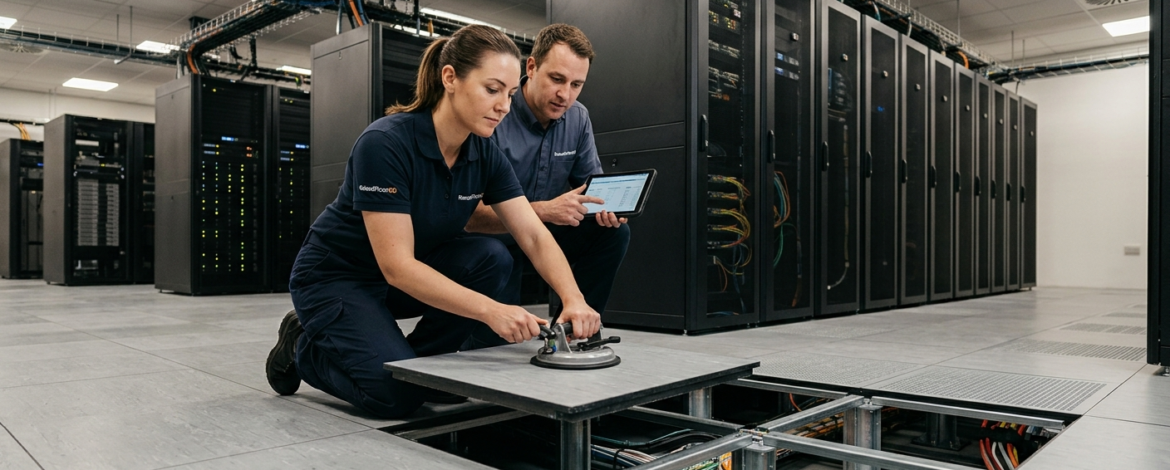
With a simple suction cup panel lifter, network engineers can easily pop up any floor tile to reconfigure lines or add hardware in minutes. This flexible design shortens deployment schedules, keeps maintenance simple, and protects sensitive cables from dust, ambient heat, and accidental physical damage.
The Best Raised Floor for Datacenter Specifications
| Specification Feature | Technical Details / Standards |
| Panel Core Material | High-density cementitious compound / Solid steel |
| Panel Outer Shell | Heavy-duty steel sheet with anti-corrosion coating |
| Top Finish Options | High-Pressure Laminate (HPL), Conductive PVC, or Bare Steel |
| Standard Panel Dimensions | 600 mm x 600 mm (or 24″ x 24″) |
| Panel Thickness | 30 mm to 35 mm depending on load classification |
| System Weight | Approx. 13 kg to 16 kg per panel |
| Concentrated Load Capacity | 1,000 lbs to 2,500 lbs (4,450 N to 11,120 N) |
| Ultimate Load Rating | Over 3,000 lbs up to 7,500 lbs per panel |
| Uniform Distributed Load (UDL) | 300 lbs/sq.ft to 800 lbs/sq.ft |
| Rolling Load Rating (10-pass) | 800 lbs to 2,000 lbs |
| Perforated Panel Airflow Rates | 25% to 55% open area configurations available |
| Pedestal Height Adjustment Range | 150 mm up to 1,500 mm (Customizable) |
| Pedestal Axial Load Strength | Up to 22 kN (Kilonewtons) resistance |
| Electrical Resistance / Grounding | 1.0 x 10^6 to 1.0 x 10^9 Ohms (Anti-static) |
| Fire Safety Certification | Class A Flame Spread / Non-combustible core rating |
Why Choose Our Raised Floor Systems?
-
Premium Brand Partnerships: We supply industry-approved ATFLOR and ZTFLOOR systems, certified globally for high-performance enterprise applications.
-
Total Customization: From low-profile wire management layouts to deep underfloor cooling plenums, we adapt pedestal heights to fit your building’s specific architecture.
-
Complete Accessory Ecosystem: We offer a full catalog of supporting hardware, including heavy-duty suction cup lifters, custom access ramps, and brush-sealed cable grommets.
-
Local Expertise & Fast Turnaround: Based in Dhaka, Raised Floor Bangladesh provides rapid product delivery, technical consulting, and reliable installation support.
Pros and Cons of Premium Raised Flooring
| Pros | Cons |
| Flawless Thermal Efficiency: Underfloor plenums provide precise, direct cooling to high-density server racks. | Higher Upfront Capital Cost: Requires a larger initial investment compared to simple concrete slab floors. |
| Infinite Scalability: Swap out, run, or clean cables instantly by lifting individual modular panels. | Clearance Constraints: Requires sufficient ceiling height to maintain room comfort after lifting the floor. |
| Superior Grounding & Safety: Anti-static HPL and PVC coatings protect sensitive microchips from static shock. | Maintenance Tasks: Requires periodic underfloor cleaning to prevent dust buildup in the airflow stream. |
| Heavy Load Ratings: Safely supports heavy enterprise server enclosures, battery arrays, and cooling gear. | Professional Installation: Demands precision laser leveling during setup to prevent panel rocking. |
Frequently Asked Questions
1. Why is an anti-static finish necessary for a data center raised floor?
Static electricity can destroy sensitive microchip architectures and trigger unexpected system reboots. High-Pressure Laminate (HPL) and conductive PVC floor finishes safely bleed off static charges to the grounded steel grid beneath, shielding your servers from static issues.
2. What is the difference between solid panels and perforated panels?
Solid panels form the walkable floor space and keep cold air pressurized in the plenum underneath. Perforated panels feature open slots or grilles, allowing cold air to flow up into hot server aisles for targeted thermal management.
3. How much weight can the best raised floor for datacenter environments actually support?
Our high-tier panels support concentrated loads starting from 1,000 lbs up to 2,500 lbs on a single square inch, with ultimate safety load limits reaching 7,500 lbs. This effortlessly accommodates heavy blade enclosures and power units.
4. Can I adjust the height of the floor after it has been installed?
The steel pedestals feature threaded locking shafts that allow for small leveling adjustments during maintenance. However, the overall height range is locked in during the initial installation based on your design goals.
5. How do airflow management devices improve energy efficiency?
Devices like brush grommets seal the cutout holes where cables pass through the floor. By stopping cold air from escaping through unapproved gaps, your cooling system runs more efficiently, directly lowering your PUE score and energy bills.
|
|
|
|