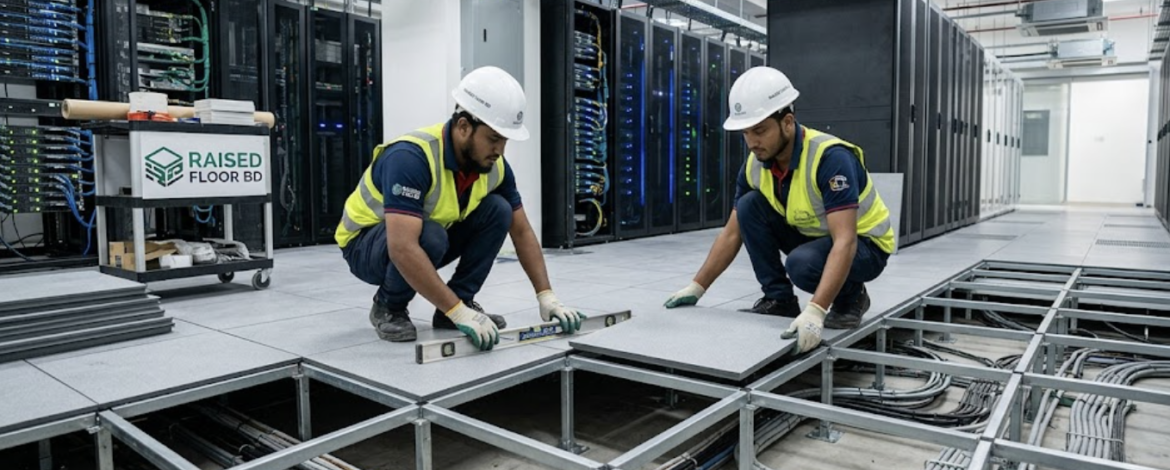
Transform Your Infrastructure with a Premium Raised Access Floor
Modern commercial architecture requires dynamic adaptability, unmatched durability, and absolute structural safety. A premium Raised Access Floor system serves as the definitive foundational architecture for high-density tech environments, corporate workspaces, and industrial hubs across Bangladesh. By creating an elevated, adaptable underfloor plenum, these platforms deliver seamless spatial organization. They effortlessly house intricate networks of power cables, high-speed data lines, plumbing lines, and specialized HVAC climate systems. This strategic configuration eliminates visible layout clutter while providing immediate, tool-free access to your underlying critical utility grids.
Upgrade to a Future-Proof Raised Access Floor Infrastructure
Engineered Performance for High-Density Operational Zones
Rapid shifts in commercial architectural design demand infrastructure that pivots smoothly alongside technological progress. The contemporary workspace is no longer a static physical environment; it functions as an evolving digital nervous system. Implementing a heavy-duty Raised Access Floor system completely redefines how your building operates from the ground up. This innovative elevated framework bypasses the severe limitations of rigid, permanent traditional flooring by introducing a completely modular modular grid.
Constructed from premium steel-encased concrete composites, high-density calcium sulfate cores, or lightweight structural aluminum, these versatile architectural panels sit securely on top of an adjustable steel understructure. This clever engineering allows corporate facilities, control command centers, and industrial hubs to reroute heavy electrical layouts or update network architecture in real time, bypassing the high costs of masonry work or intensive structural disruptions.
+-------------------------------------------------------------+
|                     Top Cover (HPL/PVC)                     |
+-------------------------------------------------------------+
|          Solid Panel Core (Steel/Calcium Sulfate)           |
+-------------------------------------------------------------+
|    [Plenum Space: Network Cables, Power Lines, HVAC Air]    |
+-------------------------------------------------------------+
|====== Pedestal Head ====== Pedestal Head ====== Pedestal ===|
|          |                     |                     |      |
|    Steel Pedestal        Steel Pedestal        Steel Pedestal|
|          |                     |                     |      |
+----------v---------------------v---------------------v------+
|                     Concrete Subfloor Baseline               |
+-------------------------------------------------------------+
Optimized Thermal Regulation and Intelligent Cable Routing
In intense technical environments like enterprise server spaces and carrier data centers, managing heat loads is a constant operational battle. Traditional overhead air duct systems often run continuously at maximum capacity, resulting in inefficient thermal distribution and soaring corporate energy bills. An intelligent Raised Access Floor solves this design bottleneck by transforming the subfloor cavity into a pressurized underfloor air distribution (UFAD) plenum.
By strategically integrating specialized perforated panels and directional airflow grilles, cold air can be guided straight to heavy equipment intakes. This targeted thermal cooling reduces overall HVAC load and significantly prevents hardware degradation from localized hotspots.
Beyond optimized temperature control, this modular layout simplifies complex cable management. Tangled wires are moved beneath the surface, protected by integrated brush grommets and secure cable trays. This approach eliminates trip hazards, enhances workspace aesthetics, and ensures safety compliance across your facility.
Long-Term Versatility for Agile Architectural Design
The true value of a premium modular floor system lies in its exceptional architectural versatility. Traditional concrete-embedded wiring structures tie a building to its initial design day one, forcing companies into expensive and disruptive drilling work whenever they need to scale up operations.
In contrast, our modular panels can be lifted quickly using ergonomic suction cup lifters, granting immediate access to underfloor systems without disturbing surrounding office activities. Whether you are reconfiguring open-plan corporate workstations, integrating new cleanrooms, or expanding a telecom station, this modular architecture adapts quickly to support your business growth.
Raised Access Floor Specifications
| Performance & Engineering Parameters | Technical Standard & Material Matrix Values |
| Standard Grid Panel Dimensions | 600 mm x 600 mm (Standard Architectural Profile) |
| Available Panel Core Compositions | Heavy-Duty All-Steel, Calcium Sulfate, Die-Cast Aluminum |
| Top Surface Finish Varieties | High-Pressure Laminate (HPL), Anti-Static PVC, Bare Steel |
| Adjustable Pedestal Height Array | 100 mm up to 1500 mm (Customizable Range) |
| Concentrated Load Threshold | 3,000 N to over 5,000 N (Based on Panel Selection) |
| Ultimate Uniform Load Capacity | 15,000 N/m² up to 33,000 N/m² |
| Impact Loading Resistance | Minimized deformation at ≥ 670 N drop test parameters |
| Safety Fire Rating Compliance | Class A Incombustible Material (BS 476 Part 4 Standards) |
| Flame Spread & Smoke Index | Zero Flame Spread / Low Smoke Density Verification |
| Electrical Ground Resistance Range | $1.0 \times 10^6 \Omega$ to $1.0 \times 10^9 \Omega$ (Anti-Static Metric) |
| Sound Acoustic Insulation Index | Noise Reduction Coefficient rating spanning 32dB – 48dB |
| Base Material Pedestal Finish | Electro-Galvanized Zinc Coating / Anti-Corrosive Layer |
| Stringer System Grid Alignment | Heavy-gauge steel channels with sound-dampening gaskets |
| Perforated Airflow Panel Options | 15%, 25%, 32%, up to 45% open area airflow variations |
| Total System Weight Average | Approximately 28 kg/m² to 45 kg/m² depending on build |
Why Choose Raised Access Floor Systems?
-
Total Layout Flexibility: Modify your entire building layout, add complex communication paths, or upgrade power grids instantly without cracking open concrete floors.
-
Energy-Efficient Cooling: Utilize the subfloor plenum space for Underfloor Air Distribution (UFAD), drastically lowering operational cooling costs.
-
Streamlined Cable Management: Keeps thick data bundles and power lines tucked away safely in dedicated pathways under the floor panels.
-
Exceptional Static Load Capacity: Built from heavy-duty structural steel and dense core composites to support heavy server racks and heavy equipment safely.
-
Advanced Static Dissipation: Anti-static HPL and PVC surface finishes discharge electrostatic buildup safely, protecting sensitive server circuits from unexpected data loss.
Product Advantages & Disadvantages
| System Advantages (Pros) | System Disadvantages (Cons) |
| Quick, tool-free access to hidden infrastructure for maintenance. | Higher initial capital installation costs than basic concrete slabs. |
| Streamlines architectural modifications and future office layouts. | Requires precise subfloor leveling during the initial setup. |
| Drastically improves airflow in server rooms via adjustable floor grilles. | Requires specialized suction lifters to pull panels up correctly. |
| Reduces workspace ambient noise levels through integrated core panels. | Creates a hidden crawlspace that requires regular dust maintenance. |
| Keeps power, data, and plumbing systems safe from accidental impact. | Minor loss of total floor-to-ceiling room height. |
Frequently Asked Questions
1. What core materials are used to construct a Raised Access Floor panel?
The panels are manufactured using specific core structures tailored to different environments. The most popular versions feature an all-steel welded shell filled with lightweight, high-strength foaming cement. For advanced acoustic isolation and strict fire safety requirements, high-density calcium sulfate cores are used. Lightweight, precision-molded aluminum panels are typically reserved for specialized cleanrooms and medical imaging facilities.
2. How do these flooring panels protect data centers from static discharge?
Our panels are finished with specialized high-pressure laminates (HPL) or custom conductive PVC coatings. These technical surfaces interact directly with a conductive copper grounding tape network woven through the understructure pedestals. This setup bleeds off static electricity safely into the building’s main grounding matrix, protecting sensitive microprocessors from static damage.
3. What is the role of underfloor stringers in this elevated layout?
Stringers are heavy-duty, horizontal steel channels that connect the vertical pedestal heads together to form a highly stable grid network. They add lateral stability, eliminate structural shifting from foot traffic, and increase the system’s overall load capacity across the entire floor.
4. Can a Raised Access Floor system be installed in older commercial buildings?
Yes, they are highly effective for upgrading older buildings. The vertical steel pedestals can be adjusted independently to compensate for uneven, dipping, or damaged concrete subfloors. This transforms older, uneven spaces into perfectly level, tech-ready commercial environments.
5. How often do underfloor plenum spaces require professional cleaning?
In typical corporate offices, a thorough inspection and underfloor cleaning are recommended every 12 to 18 months. However, for high-traffic data centers or mission-critical server environments, checking and cleaning the plenum space every 6 months helps prevent dust buildup from entering server cooling fans.