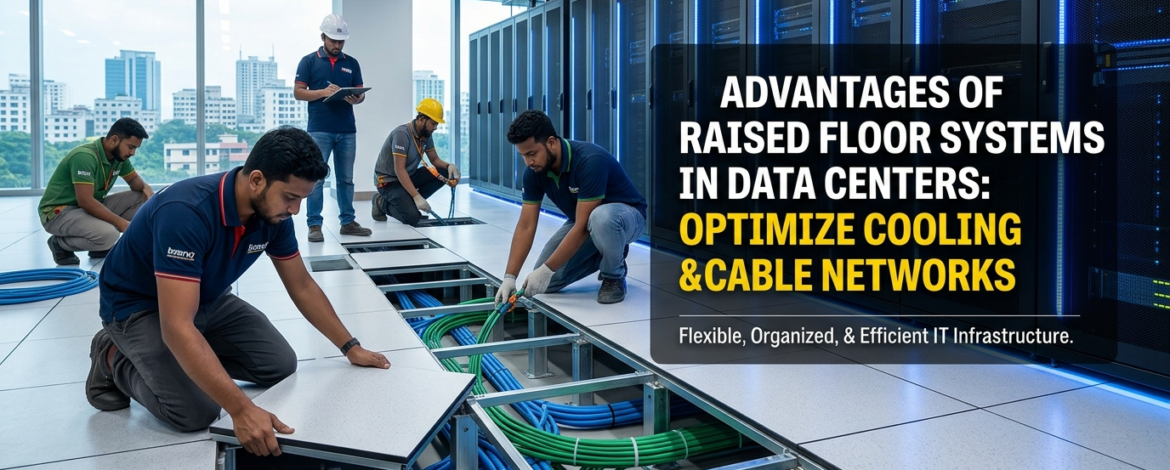
Modern information centers rely completely on architectural adaptability, absolute physical safety, and highly managed climate controls. When evaluating underfloor infrastructure solutions, understanding the distinct advantages of raised floor systems in data centers helps technical builders optimize enterprise reliability.
A professional raised platform acts as an integrated system, elevating physical hardware grids above cold concrete slabs to form a structural plenum space. This subfloor void hosts dense fiber trunks, electricity distribution blocks, and cold air corridors. Investing in this technology creates a safe, organized, and reliable environment for enterprise hardware networks in Bangladesh.
Maximizing Server Room Efficiency: The Operational Advantages of Raised Floor Systems in Data Centers
Building a reliable, highly efficient server room or cloud computing hub requires balancing structural design with daily operational realities. Traditional architectural plans struggle with the heavy demands of modern technology, which require extensive power routing, intricate fiber optic trunks, and complex climate control systems. This is why enterprise-level operations rely heavily on elevated access systems. Exploring the multi-layered advantages of raised floor systems in data centers reveals why these structural platforms are vital for maintaining maximum server uptime.
Whether you run an international bank data core in Dhaka or scale regional telecommunications nodes across Bangladesh, access floors provide absolute layout freedom. By lifting hardware setups onto modular, steel-framed panel structures, your technical crews can eliminate messy layout challenges while safeguarding expensive equipment from overheating and electrical disruptions.
Precision Micro-Climate Distribution and Energy Efficiency
Cooling infrastructure accounts for a significant portion of a data facility’s ongoing operational expenses. Traditional overhead cooling setups frequently struggle to lower hot zone temperatures efficiently, as chilled air tends to mix with rising heat before reaching critical components. Raised access platforms overcome this limitation by turning the entire subfloor void into a pressurized air delivery channel (or plenum).
By placing specialized perforated tiles or aluminum airflow panels directly in front of dense blade enclosures, engineers can deliver targeted cooling precisely where it’s needed. This cold-aisle configuration eliminates hot spots, lowers system power demands, and improves your overall Power Usage Effectiveness (PUE) ratings.
Organized Underfloor Substructures & Dynamic Layout Maintenance
Modern server setups contain complex arrays of fiber channels, safety grounding links, and electrical feeds. Leaving these grids exposed on open surfaces creates tripping hazards and leaves connections vulnerable to damage during routine structural checks.
+-----------------------------------------------------------+
|          MODULAR DATA CENTER AIRFLOW & UTILITY VIEW        |
+-----------------------------------------------------------+
|   +-------------------+          +-------------------+    |
|   |  Server Enclosure |          |  Server Enclosure |    |
|   +---------+---------+          +---------+---------+    |
|=============|==============================|==============|
|  [Tile]     | [Perforated Tile]            | [Tile]       |
|             ▲                              |              |
|   [Pedestal]|  (Chilled Airflow)           |[Pedestal]    |
|             ▲                              |              |
|---+---------+------------------------------+---------+----|
|   |  Subfloor Base [Dense Underfloor Fiber & Power]  |    |
+---+--------------------------------------------------+----+
Elevated underfloor structures keep these lines safely tucked out of sight while ensuring they remain accessible for future expansion. When scaling your infrastructure, your IT technicians simply use a dual-cup tile lifter to lift specific modular panels. This provides quick access to underlying connection paths without disrupting surrounding operations or calling for expensive building structural adjustments.
Advantages of Raised Floor Systems in Data Centers Specifications
| Operational Vector | Technical Performance Metric / System Attribute |
| Grid Module Size | 600 mm × 600 mm (Standardized Interchangeable Form Factor) |
| Plenum Vertical Range | 150 mm to 2,000 mm adjustable space clearance |
| Core Material Selections | Die-cast Aluminum, Cementitious Steel Core, Heavy Calcium Sulfate |
| Top Finish Treatment | High-Pressure Laminate (HPL), Conductive Vinyl, or Anti-static Carpet |
| Concentrated Load Limits | Certified from 3,500 N up to 6,500 N per single module tile |
| Uniform Load Capacity (UDL) | Rated from 15,000 N/m² up to 35,000 N/m² structural limits |
| Impact Resilience Rating | Meets CISCA standards (resists structural damage from tool drops) |
| Fire Safety Certification | Class A Flame Spread rating; meets BS 476 flame standards |
| Airflow Panel Adjustability | Perforated plates available with 25%, 32%, 45%, or 55% open airflow ratios |
| Static Ground Resistance | 2.5 × 10⁵ to 1.0 × 10⁹ Ohms continuous static dissipation |
| Acoustic Dampening Value | Dampens underfloor noise by 15 dB to 22 dB across structural grids |
| Corrosion Protection | Electro-galvanized coating prevents rust on pedestals and stringers |
| Seismic Bracing Support | Available with custom anchor reinforcements for earthquake-prone zones |
| Subfloor Cleaning Finish | Polyurethane sealant prevents concrete dust from entering the airflow |
| System Weight Range | 10.5 kg to 16 kg per tile module depending on density |
Why Choose Raised Access Flooring For Server Rooms?
-
Optimized Thermal Management: Seamlessly channels localized cooling under pressure, protecting sensitive electronics from overheating.
-
Streamlined Cable Infrastructure: Removes overhead line clutter and routing tangles, creating a safer, well-organized workspace.
-
Continuous Electrostatic Grounding: Anti-static surface materials instantly drain static buildup, protecting your system hardware from damage.
-
Flexible Equipment Adjustments: Allows for easy facility expansions and configuration updates with minimal operational downtime.
Pros and Cons: System Performance Comparison
| Strategic System Advantages | Implementation Factors to Manage |
| Maximizes space utility by moving heavy cabling under the floor. | Involves higher upfront material and construction investments. |
| Supports high-density server configurations with reliable weight load capacities. | Reduces vertical room height clearance by creating an elevated subfloor. |
| Interchangeable tiles allow for easy maintenance and replacement. | Requires flat concrete preparation before installing pedestals. |
| Enables targeted airflow adjustments by swapping solid and perforated tiles. | Requires periodic subfloor vacuuming to prevent dust buildup. |
Product FAQs
-
Why are the advantages of raised floor systems in data centers so crucial for cooling?
They create a dedicated underfloor path that acts as a pressurized cooling channel. This design directs cold air straight to hot server racks through perforated panels, preventing warm ambient air from reducing cooling efficiency.
-
Can these elevated floor tiles safely support ultra-heavy server enclosures?
Yes. Heavy-duty options, such as steel-encased cementitious tiles or calcium sulfate cores, are engineered to handle concentrated loads exceeding 5,000 N, providing steady support for modern hardware arrays.
-
Which panel top finish is recommended for electronic hardware zones?
High-Pressure Laminate (HPL) is the preferred choice for server facilities. It is highly resistant to scratches and helps continuously discharge static electricity, protecting equipment from static-related issues.
-
How easy is it to reconfigure cables after the system is fully installed?
It is incredibly straightforward. Technicians use a simple tile suction lifter to raise specific modular tiles, allowing them to route new power or fiber lines without halting daily business operations.
-
What maintenance do access flooring systems require?
The surface should be cleaned regularly with specialized anti-static micro-mops, avoiding excessive water. Additionally, the underfloor void should be vacuumed every few years to keep the airflow free of dust.