Affordable Access & Raised Floor Price in BD: Materials, Installation, and Brands
The Complete Guide to Affordable Access & Raised Floor Price in BD: Materials, Installation, and Brands
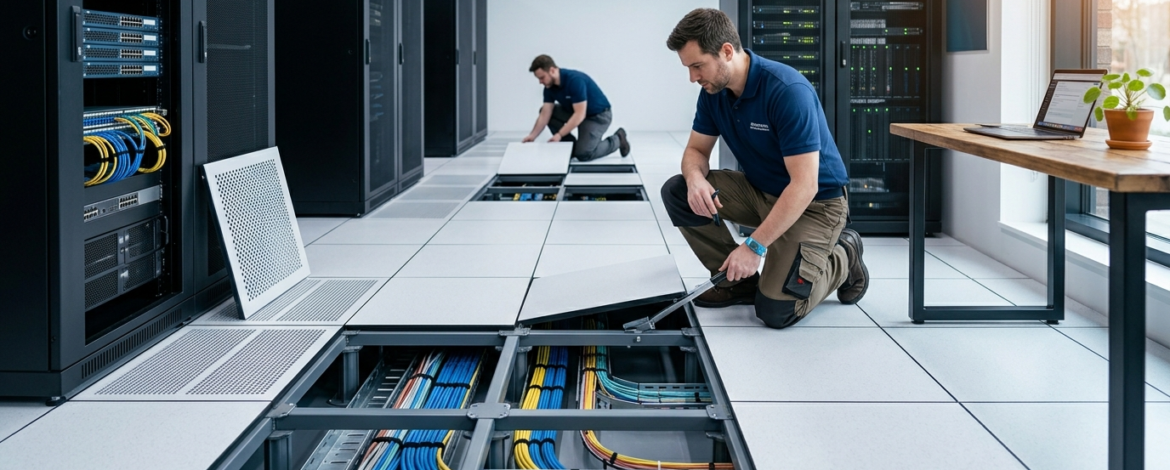
Modern infrastructure demands flexibility. In any commercial building or data center across Bangladesh, a traditional concrete slab floor quickly becomes a nightmare for maintenance teams. Every time a network cable fails or a power line needs upgrading, tearing up traditional finishes is expensive and disruptive. That is where a smart raised access floor system comes into play. It creates an accessible underfloor plenum (air space) that hides your utility lines while making them accessible in seconds.
Understanding the Materials: What Goes Into a Raised Floor?
When looking into an Affordable Access & Raised Floor Price in BD: Materials, Installation, and Brands, the raw materials are what drive the baseline cost. Not all panels are engineered the same way:
-
Steel-Encapsulated Concrete Core: These are the gold standard for data centers and server rooms. They feature a heavy-duty steel shell filled with structural cement injection. This combination makes them incredibly silent to walk on, exceptionally rigid, and completely immune to warping under heavy rack loads.
-
High-Density Particle Board/Wood Core: If you are configuring a standard commercial office or call center, wood-core panels offer an excellent, lightweight, and cost-effective alternative. They provide great acoustic absorption while keeping your upfront material costs lower.
-
Perforated Steel Panels: These are necessary for active airflow management. Placed strategically in front of server racks, they allow cold air from underfloor cooling systems to blow directly upward, preventing expensive hardware from overheating.
Supporting these panels are adjustable steel pedestals and horizontal stringers. These structural components are hot-dip galvanized to resist humidity and rust—a critical factor considering Bangladesh’s tropical climate.
Top Brands Leading the Market in Bangladesh
Navigating the brand landscape helps ensure you get a certified product that will not buckle under load. The local market relies heavily on a few trusted international manufacturers known for consistent quality control:
-
ATFLOR Raised Floor Systems: Renowned for their high structural loading capacity and superior anti-static properties, ATFLOR panels are heavily favored in corporate offices and medical imaging rooms.
-
Ztfloor Flooring Solutions: Ztfloor offers a highly competitive balance of quality and affordability. Their anti-static steel raised floors are a staple for medium-to-large scale server rooms and command centers across Dhaka and Chittagong.
Professional Installation and Structural Setup
Buying high-quality materials is only half the battle; installation is where the system succeeds or fails. A poorly installed raised floor will creak, rock, or develop uneven gaps that create safety hazards.
The installation process begins with an accurate laser leveling of the subfloor. Adjustable steel pedestals are glued down with high-strength epoxy or mechanically anchored to the base concrete slab. Horizontal steel stringers are then fastened to the pedestal heads to form a perfectly square structural grid. Finally, the panels are laid into the grid. A professional setup ensures that individual panels can be lifted easily with a suction cup lifter at any time without compromising the structural integrity of the surrounding floor.
Realizing Long-Term Value
Investing in a raised floor system is a strategy that saves operational costs over time. Instead of spending money on expensive wall channelling or ceiling drop trays during every office layout change, your maintenance team can simply lift a few tiles, reroute the necessary wires, and drop the tiles back into place. This eliminates costly business downtime and keeps your operational workflow moving forward seamlessly.
System Specifications Matrix
| Feature / Detail | Standard Technical Specification |
| Primary Panel Dimensions | 600 mm x 600 mm |
| Panel Core Options | Steel-encapsulated cementitious concrete / High-density particle board |
| Top Finish Varieties | Anti-static HPL (High-Pressure Laminate) / PVC / Carpet tile / Bare steel |
| Concentrated Load Rating | 3,000 N to 5,000 N (depending on grade) |
| Ultimate Uniform Load | Greater than 12,000 N per square meter |
| Standard Pedestal Heights | Adjustable from 100 mm up to 1500 mm |
| Pedestal Material | Electro-galvanized or hot-dip galvanized heavy-duty steel |
| Stringer Design | Snap-on or bolt-on box steel tubing |
| Fire Protection Class | Class A / Incombustible core material |
| Airflow Panel Open Area | 15% to 55% perforation options available |
| Impact Insulation Class | High acoustic dampening capability |
| System Weight | Approx. 11 kg to 15 kg per panel |
| Rust Resistance | Anti-corrosion zinc coating for high-humidity climates |
| Grounding Capacity | Integral electrical continuity for static dissipation |
| Lifter Tool Compatibility | Dual or single suction cup vacuum lifter |
Why Choose This Raised Floor System?
-
Unmatched Cable Accessibility: Say goodbye to exposed cords and cluttered office walls. All power, data, and communication lines are hidden directly underfoot but remain accessible in seconds.
-
Optimized Air Distribution: Functions perfectly as an underfloor plenum to distribute cold air directly to critical equipment, cutting energy costs in server environments.
-
Future-Proof Adaptability: Need to add more workstations or move server racks next year? The modular panels allow you to adapt your layout without breaking through concrete.
Pros and Cons Analysis
| Advantages (Pros) | Limitations (Cons) |
| Simplifies electrical, data, and mechanical modifications. | Requires higher upfront investment than traditional tiling. |
| Anti-static HPL finishes protect sensitive electronic servers. | Reduces the total vertical clearance height of the room. |
| Hot-dip galvanized framing prevents rust in humid climates. | Requires professional laser leveling during initial setup. |
| Damaged individual tiles can be swapped out easily. | Needs periodic cleaning of the subfloor void to prevent dust accumulation. |
Frequently Asked Questions
1. How much does a raised floor installation cost in Bangladesh?
The total cost varies depending on the panel core material (concrete vs. wood core), the required pedestal clearance height, and the chosen brand (like ATFLOR or Ztfloor). Standard commercial projects are priced competitively on a square-foot basis, factoring in both material delivery and precise on-site installation.
2. Can these floors handle heavy equipment like enterprise server racks?
Yes, absolutely. The concrete-filled steel panels are specifically engineered to support heavy static loads. It is crucial to verify the concentrated load specifications of the specific panel grade to match the weight profile of your heaviest server racks.
3. What top finish is best for a standard corporate office environment?
For busy corporate spaces, carpet tiles or anti-static PVC finishes are ideal because they reduce walking noise and look elegant. For server rooms, an anti-static HPL (High-Pressure Laminate) finish is always recommended to handle static charges.
4. How do you access the wires once the raised floor panels are put down?
Accessing the underfloor area is simple. Your team can use a double suction cup panel lifter to safely pull up individual tiles without disturbing the surrounding floor panels.
5. Is moisture or rust an issue for raised floors in Bangladesh?
Not if you use high-quality systems. Reputable brands feature anti-corrosion, galvanized steel understructures (pedestals and stringers) that are designed to withstand the ambient humidity common across Bangladesh.
|
|
|
|