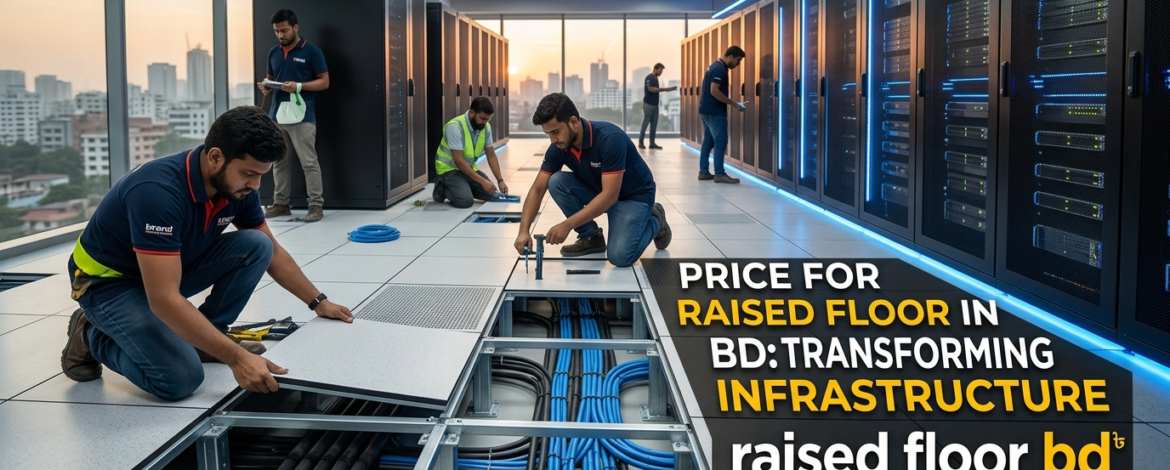
Price for Raised Floor in BD: Transform Your Infrastructure
Investing in modern infrastructure requires balancing long-term functionality with smart financial decisions. If you are looking to optimize your server room, commercial hub, or data facility, securing a premium yet competitive price for raised floor in bd is the foundational step toward building a highly flexible workspace.
Modern intelligent buildings demand smarter underfloor management systems. By integrating an advanced architectural flooring platform, your facility gains clean, uninhibited pathways to house heavy power cables, sensitive communication lines, and HVAC data links out of plain sight. Discover an affordable, highly durable architectural asset that elevates safety, thermal management, and aesthetic quality across workspaces in Bangladesh.
Unlocking Workspace Potential: A Guide to the True Value and Price for Raised Floor in BD
Creating a future-proof, high-performance office or technical workspace requires an intelligent infrastructure plan. In the rapidly evolving corporate landscape of Bangladesh, the standard concrete subfloor is no longer sufficient to support complex data networks, massive power routing, and sophisticated climate control units. This architectural challenge is exactly why forward-thinking enterprises are investing heavily in access flooring technology. Finding the right equilibrium of quality, structural capacity, and the actual price for raised floor in bd is critical to transforming your facility into a seamless, high-efficiency ecosystem.
Whether you are designing a high-tier enterprise data center in Dhaka, a dynamic call center, or a sleek corporate corporate space, choosing an anti-static access system pays dividends. It completely hides messy data trunks, safeguards personnel from accidental electrical shocks, and makes structural modifications as simple as lifting out a single tile.
The Financial Architecture: What Determines the Investment Cost?
When evaluating options across local suppliers, the final quote is never a single, uniform figure. Instead, it is built around distinct material factors and technical requirements:
- Core Substrate Composition: Calcium sulfate cores deliver stellar acoustic dampening and fire resistance ratings but carry a higher price tag. Light-weight, steel-encased cementitious tiles offer excellent load distribution and remain a highly popular, budget-friendly baseline for local commercial projects.
- Top Covering Choices: High-Pressure Laminate (HPL) or specialized anti-static PVC tiles are vital for cleanrooms, server racks, and power distribution zones because they mitigate static charge generation. Standard Office Automation (OA) bare networks utilize naked steel plates intended to be layered with carpet tiles or luxury vinyl planks (LVT).
- Understructure Design and Height: Standard pedestals providing a minimal 100mm clearance cost less than heavy-duty, adjustable steel pedestals designed to elevate floors to 600mm or higher to handle robust underfloor air distribution (UFAD) systems.
Enhancing Commercial Environments with Underfloor Systems
Traditional construction traps power lines and cooling systems in static walls or drop ceilings, making future upgrades expensive and disruptive. Modern raised floors solve this issue.
If your organization needs to deploy new fiber optic arrays or reconfigure a floor layout, your IT maintenance crew can seamlessly access the underlying utility grid using a simple dual-cup tile lifter. This eliminates the need to tear into drywall or disrupt daily business operations, protecting your bottom line from unnecessary downtime.
Moreover, raised access flooring solves modern thermal management challenges. By using underfloor spaces as a pressurized plenum, cool air can be pushed directly through perforated airflow panels to target hot server racks. This localized cooling method cuts cooling energy waste, lowers monthly utility expenses, and extends the operational life of your expensive IT infrastructure.
Price for Raised Floor in BD Specifications Table
| Specification Field | Technical Metric / Operational Value |
| Standard Panel Dimensions | 600 mm × 600 mm (Industry Standard) |
| Available Panel Thickness | 30 mm, 35 mm, and 38 mm variants |
| Core Materials Available | Steel-Cementitious Core, Calcium Sulfate, High-Density Particle Board |
| Top Finish Coverings | Anti-static HPL, Conductive PVC, Ceramic, or Bare Steel for Carpet |
| Bottom Plate Finish | Galvanized Steel Sheet / Clear Stretch Aluminum Foil |
| Concentrated Load Capacity | 3,000 N to greater than 5,000 N depending on core |
| Uniformly Distributed Load (UDL) | 12,500 N/m² up to 25,000 N/m² |
| Ultimate Peak Load Capacity | Greater than 9,000 N to 15,000 N |
| Impact Safety Rating | Passes CISCA Guidelines (60 kg drop test verified) |
| Adjustable Pedestal Heights | 100 mm to 1,200 mm customizable height brackets |
| Pedestal Base Sheet Diameter | 100 mm × 100 mm square or circular heavy steel base |
| System Fire Resistance | Class A Flame Spread rating (BS 476 Part 6 & 7 approved) |
| System Weight Range | 11 kg to 15.5 kg per standard individual panel panel |
| Acoustic Insulation Performance | Delta Lw insulation range of 14 dB to 18 dB |
| Electrical Ground Resistance | 2.5 × 10⁵ Ohms to 1.0 × 10⁹ Ohms (Static Dissipative) |
Why Choose Raised Access Flooring For Your Space?
- Optimized Micro-Climate Air Distribution: Utilizing the underfloor void for displacement ventilation drastically improves indoor air quality while reducing overall HVAC operating costs.
- Rapid Facility Adaptation: Future-proofs your physical investment against layout shifts, unexpected corporate scaling, or regular hardware upgrades.
- Uncompromised Safety & Static Protection: Anti-static surface matrices instantly discharge dangerous static buildup directly to the ground, shielding hardware and operators.
- Minimal Maintenance & Structural Longevity: Constructed using robust, corrosion-resistant galvanized materials that require minimal structural up-keep over decades.
Pros and Cons: Weighing the System Investment
| Structural Pros & Operational Wins | Critical Implementation Constraints |
| Eliminates unsightly wall-mounted conduits and overhead cable tray clutter. | Requires a higher initial material capital outlay compared to bare concrete. |
| Delivers completely modular, tool-free access to utilities anywhere on the floor. | Slightly reduces the total vertical ceiling height clearance of the room. |
| Specialized finishes insulate servers against accidental electrostatic discharges. | Demands flat subfloor preparation before pedestal anchors are secured. |
| Interchangeable tile options make damaged sections inexpensive to swap out. | Requires periodic vacuum maintenance underneath to clear dust buildup. |
Product FAQs
- What is the typical price for raised floor in bd per square foot? The price varies from BDT 280 to BDT 650+ per square foot. The final cost depends on panel choices (such as anti-static HPL versus naked OA tiles), understructure height, load requirements, and site conditions.
- Can these floors handle heavy data center server racks? Yes. Heavy-duty steel-encased cement core and calcium sulfate options are specifically engineered to support heavy weights, with concentrated load capacities exceeding 5,000 N per tile to keep your equipment secure.
- What is the primary difference between HPL and PVC top surfaces? High-Pressure Laminate (HPL) panels offer superior scratch resistance and are highly recommended for technical zones like server rooms. PVC finishes are more flexible, offer great dampening, and are easier to clean in high-traffic office spaces.
- How long does it take to install an access floor system in a standard room? A professional crew can typically install around 400 to 600 square feet of access flooring per day, provided the underlying concrete substrate is level and free of debris.
- Does the system require specialized maintenance? The surface should be cleaned with specialized anti-static cleaners, avoiding excessive water. Every few years, subfloor cavities should be inspected and vacuumed to maintain optimal air quality